
A Repeatable Review Routine for Daily AI Commits
Quick answer: When AI commits arrive daily, the review has to be a routine, not a fresh negotiation each time. Run the same sequence on every change: scope the diff against the task, read the flagged suspicions in risk order, confirm the related context, verify the changed path with real requests and a flow check, then hand off the confirmed items. A time box keeps it fast, and a fixed checklist keeps the standard from drifting when the team is busy.
Why a routine beats ad-hoc review
Without a routine, the depth of a review depends on the mood of the day. A calm afternoon gets a careful check, a rushed evening gets a glance, and the same defect is caught or missed depending on timing rather than risk. A fixed sequence applies the same standard to every commit and makes the review faster, because the reviewer no longer decides what to do next at each step.
The routine also creates a clear stopping point. Once the checklist is complete, the change is either confirmed or sent back, and the reviewer does not keep circling the same diff.
The routine at a glance
| Step | Action | Outcome |
|---|---|---|
| 1 Scope | Compare the diff against the task | In-scope and unrelated changes marked |
| 2 Suspect | Read the flags in risk order | The data-risk items first |
| 3 Context | Confirm block, symbols, callers | The trigger understood |
| 4 Verify | Real requests and a flow check | The behavior confirmed |
| 5 Gate | Check the evidence states | Partial and empty results honest |
| 6 Hand off | Export the confirmed package | The fix starts from evidence |
Running it on a daily commit
- Open the change summary and the file list, and mark each file in-scope, adjacent, or unrelated.
- Start the AI review and read the flagged suspicions in priority order, not file order.
- For each flag, confirm the trigger in the block, resolve the symbols, and follow the callers.
- Dismiss false suspicions with the reason, and keep the ones that can really fire.
- Send real requests on the changed path and run the business flow, asserting the side effect.
- Check the gate states, and treat a missing script or empty result as inconclusive.
- Export the confirmed suspicions as a task package and confirm the fix with the same request.
A time box helps. Give the static passes a bounded block and the request verification a separate block, and if a suspicion cannot be settled within the routine, it stays open rather than getting a rushed approval. Over a week, the same sequence handles every commit without the standard sliding.
Keeping the evidence in the routine
The routine should leave the same record each time, with the anchor, evidence type, reproducible command and raw output, and the decision. That consistency means a later review can rerun yesterday's checks and focus on the new diff, and the history stays defensible.
The verdict is deterministic with no LLM involved, so failing evidence fails, partial verification stays partial, and an empty result is not a pass.
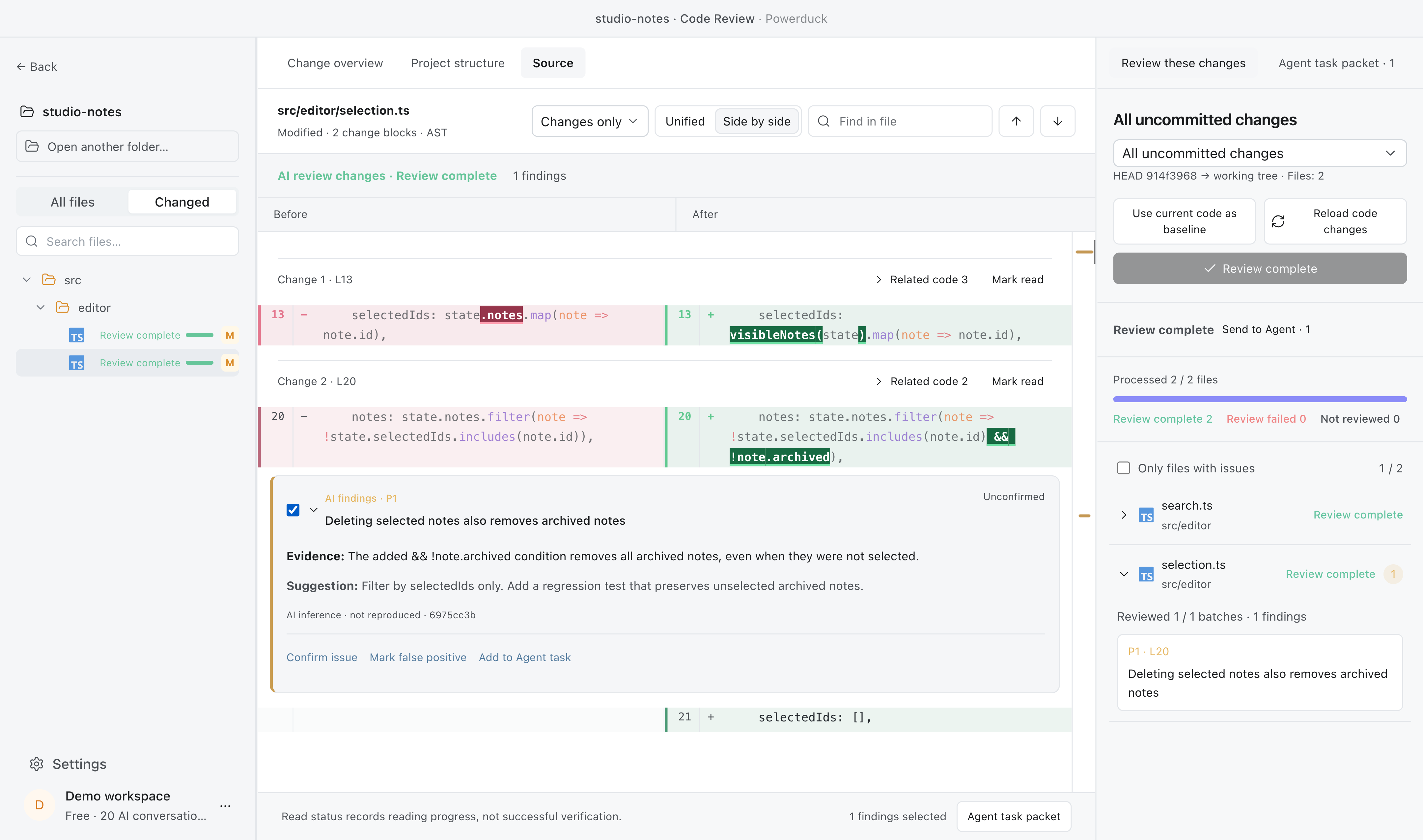
Powerduck supports the routine in one surface, from the scoped file list and flagged suspicions to the requests and the exported handoff.
Signals the routine is working
A routine earns its place when the review outcomes become predictable. Watch for a few signals rather than inventing metrics. The same kinds of defects get caught at the same gate each time, so a data-loss issue consistently fails at the dynamic request rather than reaching production. The list of open items at the human gate shrinks as the static and dynamic checks improve, because fewer questions remain unanswered. Reopened merges become rare, since a fix verified by the rerun request does not bounce back. And the time per commit stays inside the time box even as the diffs grow, which is the clearest sign the sequence is doing the work rather than the reviewer. If these signals reverse, the checklist itself needs a look rather than the team working harder.
Honest limits
A routine is only as good as the evidence it runs, and the checks still bound themselves to the paths exercised, so edge cases outside the requests remain open. Dynamic loading and external consumers can be invisible, and the model can raise false suspicions or miss defects.
When the routine cannot confirm a trigger, keep it open rather than lowering the standard to close the time box.
Frequently asked questions
How does a routine stay fast? The fixed sequence removes the decision about what to do next, and the time box keeps each block bounded.
Does the routine replace judgment? No. It applies the same standard every time, and the reviewer still decides the trigger and the open items.
What happens when a check cannot finish? The item stays inconclusive rather than getting a rushed approval.
The bottom line
Turn the review into a fixed sequence you run on every AI commit: scope, read the flags in risk order, confirm the context, verify with real requests and a flow, check the gate states, and hand off the confirmed items. A time box keeps it fast and the checklist keeps the standard consistent, and anything unconfirmed stays open rather than sliding through. The routine is what makes daily AI commits trustworthy without slowing the team. Read more in the AI code review guide.