
From Suspicion to Verified Change: A Closed Loop
Quick answer: The review of an AI change is a closed loop, not a one-time flag. It starts with a suspicion next to the diff, moves through the related context that decides the trigger, into a real request that confirms the behavior, then a handoff that carries the evidence to a coding agent, and ends when the same request verifies the fix. Break any link and the loop opens: a suspicion without context is a guess, a context without a request is static, and a fix without a rerun check is trust.
Why the loop has to close
Teams often stop at the first or the last link. A flagged suspicion is treated as a verdict and fixed without confirming the trigger, or a fix is accepted on the agent's report without rerunning the request, and both leave the change unverified. The loop is designed so every claim is backed by evidence and the final state is observed rather than assumed.
Closing the loop also makes the result reproducible. The same request that exposed the defect confirms the fix, which gives a clear before-and-after record rather than a vague sense that the problem is gone.
The five links
| Link | What happens | Evidence it produces |
|---|---|---|
| 1 Suspicion | The flag names the line and priority | A lead with a code anchor |
| 2 Context | Block, symbols, and callers are confirmed | The trigger and blast radius |
| 3 Request | A real call exercises the path | The response and side effect |
| 4 Handoff | The package carries the evidence | A confirmed fix brief |
| 5 Verify | The same request reruns | The corrected behavior |
The first link is a hypothesis, and the last link is the confirmation, and the middle three are what move one into the other.
Walking the full loop
- Start the AI review and read the flagged suspicion, its priority, and its evidence.
- Read the enclosing block, resolve the symbols, and follow the callers to understand the trigger.
- Dismiss false suspicions with the reason, and keep the one that can really fire.
- Send a real request that reaches the path and assert the response and the side effect.
- Export the confirmed finding as a task package with context and revision anchors.
- Let the coding agent assess and fix it, then rerun the same request.
- Close the loop only when the rerun shows the corrected behavior and the final state.
Take the deletion-filter defect through the whole loop. The suspicion flags the filter, the context shows one caller passes archived rows, and the request confirms the archived note is removed. The handoff carries the anchor, callers, and the failing request, and the agent adds the guard. The loop closes when the rerun request keeps the archived note and the final data state matches the expected behavior. At every link, the evidence is recorded, and nothing is taken on confidence.
Honest states at every link
The loop relies on honest verdicts. An AI-only claim stays a hypothesis, a check that does not reach the branch is inconclusive, partial verification stays partial, and only fully verified evidence passes, with the verdict determined deterministically and no LLM involved. A green build or a 200 response does not close a link on its own.
The review can still miss dynamic loading and external consumers, so the loop is bounded to the paths the requests exercise, and the edge cases outside them stay visible.
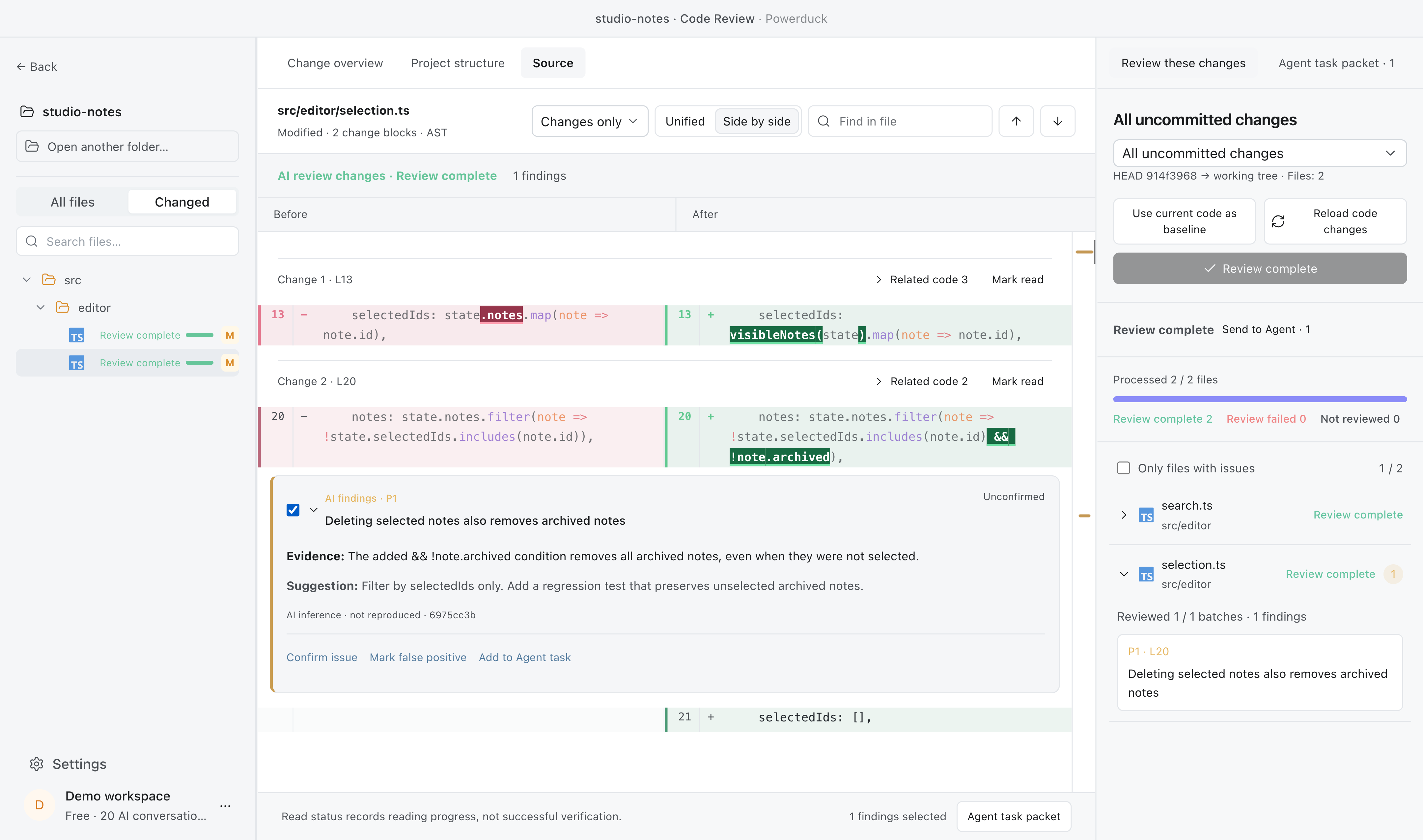
Powerduck keeps the five links in one workflow, from the flagged suspicion and the context to the request, the handoff, and the rerun that confirms the fix.
What an open loop looks like
Most review failures are loops that stopped early. A team that fixes the flagged line but never reruns the request has closed the code change and left the verification open, so a regression in a neighboring path can pass unnoticed. A team that runs the request but skipped the context may confirm a behavior that the real callers never reach, validating the wrong scenario. Even a confirmed fix leaves the loop open if the final data state is not checked, since the response can hide the storage defect. Treat each link as a dependency: the handoff rests on the request, the request rests on the context, and the final verification rests on all of them. The loop is only as strong as the link that actually ran.
Frequently asked questions
What counts as closing the loop? The same request that exposed the defect reruns and shows the corrected behavior and final state.
Which link is most often skipped? The final verification, where a fix is accepted on the agent's report without rerunning the request.
Is a suspicion ever a verdict? No. It is a hypothesis that moves through context and a request before it is confirmed.
The bottom line
Treat every AI change as a closed loop: suspicion, context, real request, handoff, and a rerun that verifies the fix, with evidence at each link and honest states for partial or inconclusive results. A suspicion without a request is a guess, and a fix without a rerun is trust. The loop is closed only when the behavior is observed, and even then it stays bounded to the paths that were checked. That is how every change earns confidence rather than assuming it. Read more in the AI code review guide.