
Reviewing a Large AI-Generated Diff Without Reading Every Line
Quick answer: When an AI tool produces a diff that spans dozens of files, reading every line in order is the slowest and least reliable way to review it. A better routine reads the diff in risk-ordered passes: first the changed behavior and the flagged suspicions with their code evidence, then the shared modules and the scope of the change, and only then the low-risk formatting. Real requests against the API confirm the behavior the diff only implies. This keeps the review fast without turning it into a rubber stamp.
Why a straight read fails on AI output
A large generated diff has a shape that works against a top-to-bottom reader. The first files in the list are often generated config, reordered imports, or renamed symbols, while the one change that actually alters behavior can sit much deeper. A reviewer who starts at line one spends attention on the safe parts and arrives at the risky part already tired.
AI output also tends to touch broadly. A single request can rename a helper, update every caller, and reformat the files in the same pass, which inflates the diff with changes that carry no behavioral risk. Treating every changed line as equally important is how a reviewer either misses the real defect or burns a day on a merge that should take an hour.
What to read first
| Pass | What you read | What you look for |
|---|---|---|
| 1 | Flagged suspicions and changed behavior | A logic change with a real trigger |
| 2 | Shared modules and their callers | One edit reaching unrelated requests |
| 3 | Data shapes and validation | A removed check or a widened type |
| 4 | Tests and runnable checks | Whether the new behavior is actually exercised |
| 5 | Renames, formatting, generated files | Confirm nothing behavioral hides inside |
The ordering is the point. A suspicion that already carries a priority and a code anchor gives you a place to start, and the diff can be read around that anchor rather than from the first file. Most lines in pass five need a glance, not a deep read, once you confirm they are mechanical.
Running the passes
- Get the change summary and the list of files, grouped by how heavily each is referenced.
- Open the flagged suspicions first, read the evidence, and confirm the trigger against the surrounding code.
- Follow the shared symbols to their callers so a helper edit does not reach a request you never opened.
- Read the validation and the data-shape changes, where a removed guard is the common failure.
- Check whether a runnable test covers the new path, and treat a missing script as unverified rather than passed.
- Save the mechanical renames and formatting for the last pass, once the behavior is settled.
A concrete example helps. Suppose the diff changes how a selection filter handles archived notes. The first pass opens the flagged line, reads the new condition, and the reviewer sees that archived notes are now excluded from deletion. The second pass follows the filter to the two callers and confirms one of them still expects archived rows. That is the defect, and it is found before the reviewer touches the forty files of renamed imports below it.
Where the tooling fits
The review surface is built to support this order. The AI review starts only when you ask for it, reads the current differences with bounded related context, and returns a priority, evidence, and a recommendation next to the change rather than in a separate report.
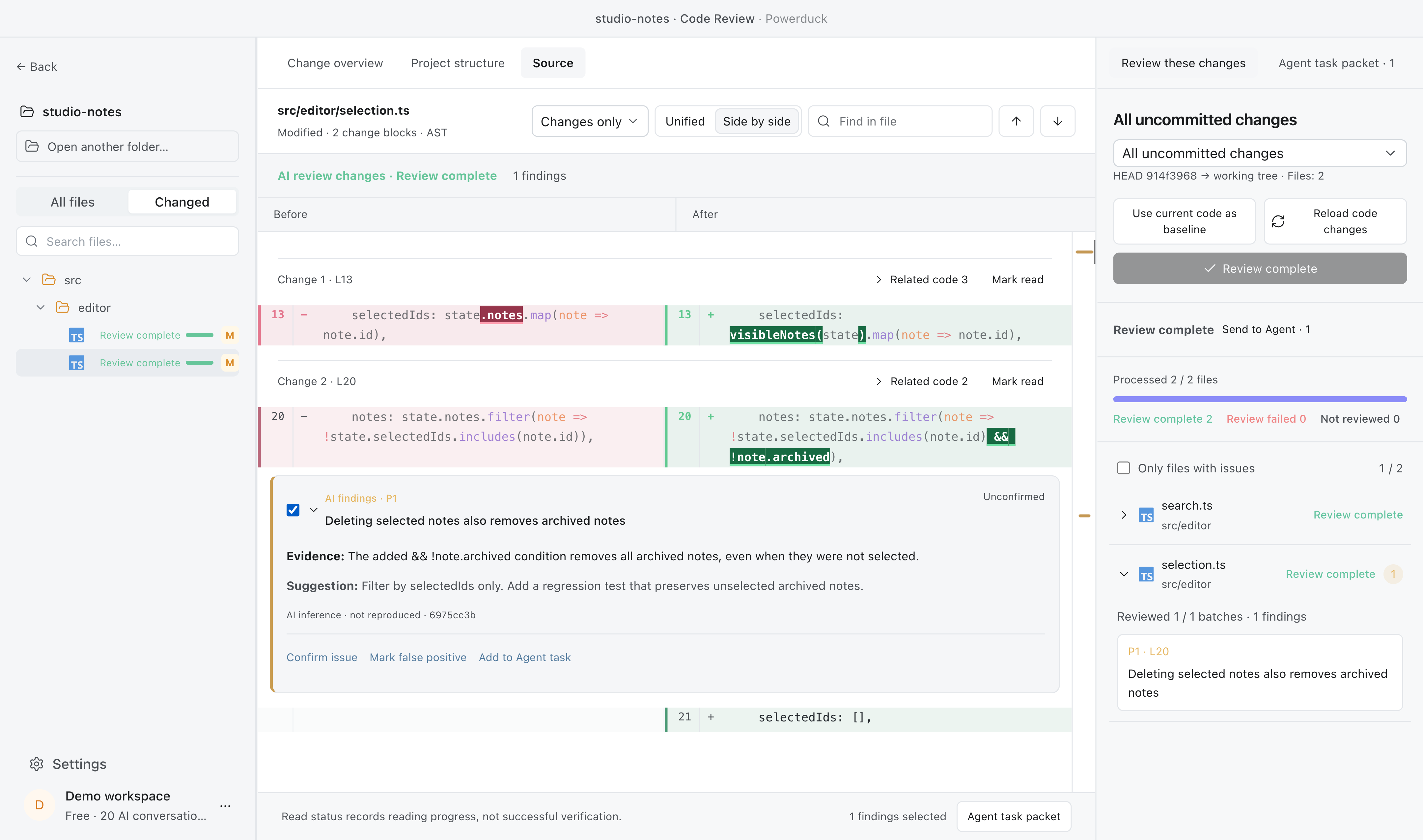
Powerduck keeps the suspicion, the evidence, and the diff in one view so the reviewer moves from the flagged line to the related code without rebuilding the context by hand.
Honest limits
A pass-based review is still a review of static changes, and it can miss what the diff does not show. Dynamic loading, framework entry points, and external consumers can be invisible, and a file with no incoming references is not automatically safe to delete. The AI can raise a false suspicion or miss a real defect, and it does not run the app, which is why the real request against the live behavior is a separate step rather than an optional one.
Treat the suspicion as a lead that needs confirmation, not a verdict, and keep the evidence classified so an AI-only claim stays a hypothesis until a runnable check backs it.
Frequently asked questions
Is skipping lines the same as approving them? No. The low-risk mechanical changes still get a confirming pass, but they do not get the same depth as a behavioral change.
How do I know a rename is really mechanical? Follow the symbol to its definition and callers, and rely on the parser to resolve them rather than trusting the changed text alone.
What if there is no test for the risky path? The change stays unverified, and a real request or a new test is needed before the merge rather than assuming the empty result is a pass.
The bottom line
You do not need to read every line of a large AI diff; you need to read the right lines in the right order, starting with flagged suspicions and changed behavior, then the shared code and validation, and leaving the mechanical edits for last. Confirm the risky path with a real request, because static reading never runs the app. A straight top-to-bottom read spends your attention on the safe files and still misses the defect. For more on this workflow, see the AI code review guide.