
Reviewing Chained API Changes Across Multiple Steps
Quick answer: When a change touches more than one step in a request chain, the review has to follow the chain rather than the files. Map the steps, mark where the change alters a request or an extracted value, and review each handoff, because a field renamed or removed in an early step can break a later call. Then run the full sequence to confirm the change holds across the steps rather than at the single endpoint where it was made.
Why chained changes are hard to read
A diff is organized by file, but a chain is organized by order, and a single logical change can appear as small edits spread across several operations. Reading the files separately, the reviewer sees a renamed field here and a new condition there, without the sequence that shows how the output of one feeds the input of the next.
The risk concentrates at the handoff. If an early step stops returning a value, or changes its shape, the later step that extracts it fails or receives the wrong data, and neither endpoint is wrong on its own. The defect is in the relationship between them.
Where to focus the review
| Point | Review question |
|---|---|
| First changed step | Does it still return the values later steps extract? |
| Extracted variables | Are the names and shapes still valid downstream? |
| Each handoff | Does the next call receive what it expects? |
| Added or removed step | Does the chain still reach its final state? |
| Shared field | Does every step using it agree on the type? |
The extracted-variable row is the most common break point, because a change that looks harmless at the producing endpoint silently starves the consuming one.
The review routine
- Draw the chain in execution order, including the extracted values passed between steps.
- Mark every step the change touches and the fields it alters.
- For each extracted value, confirm the producing step still returns it in the same shape.
- Follow each handoff to the consuming call and check its assertions.
- Look for a shared field whose type changed, since every step using it has to agree.
- Run the full sequence and confirm the final state, not just the changed endpoints.
Consider a change that renames a list field from notes to visibleNotes. The producing endpoint is correct, but the next step extracts the old notes name and now gets an empty value, which only surfaces when the chain runs. The review catches it at the handoff before the run, and the scenario then confirms the fix once the extraction is updated. Without mapping the chain, the rename would merge as a clean-looking change.
Static review plus the run
The static pass maps the structure and the handoffs, using the local parser to resolve how the steps connect, and the run confirms the behavior with real extracted values. Keep both, because the map can miss dynamic behavior and the run without the map is slow to diagnose when a step fails.
The evidence stays classified, and an AI-only claim remains a hypothesis until a runnable check backs it. The deterministic verdict treats partial verification as partial and an empty result as not a pass.
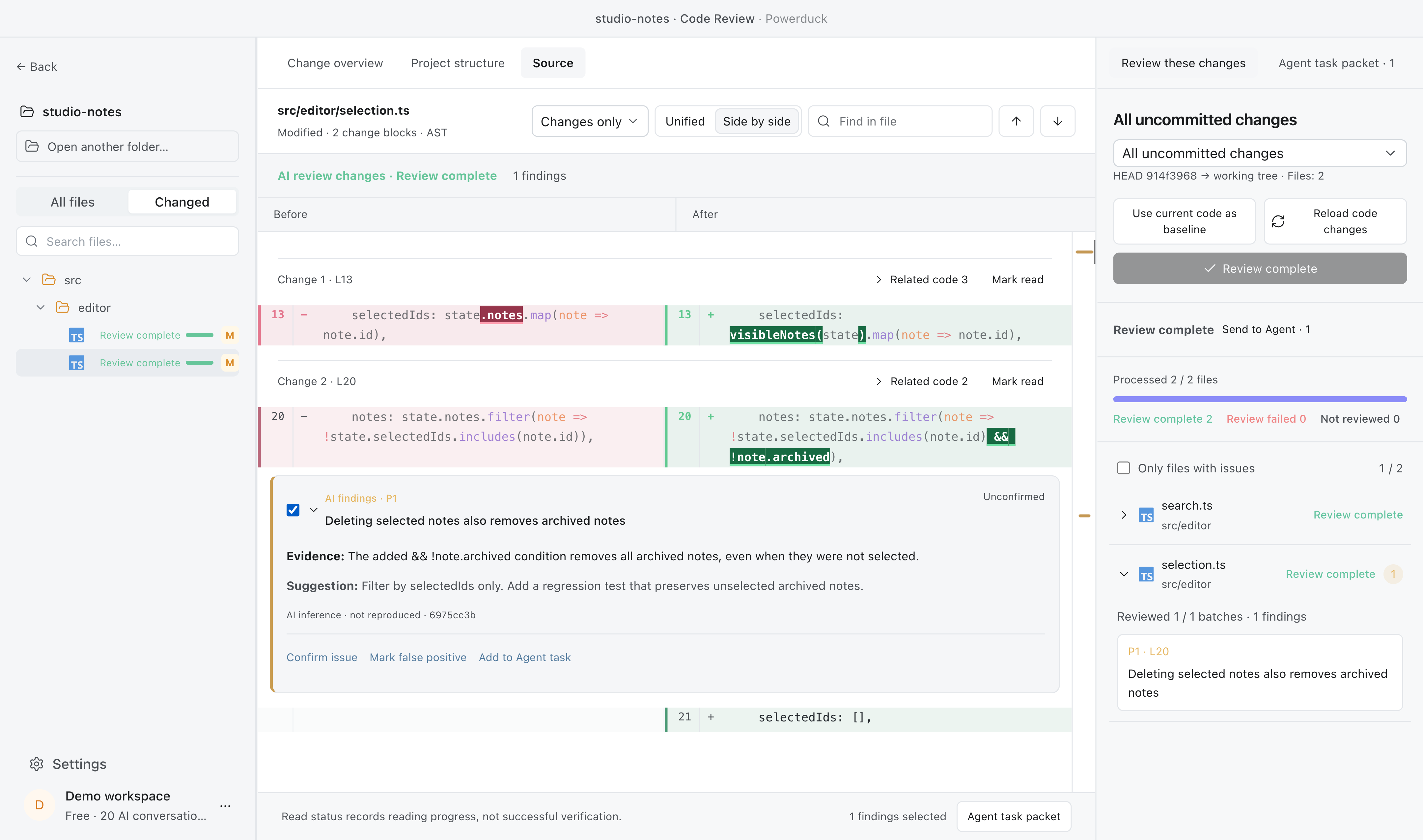
Powerduck keeps the chain map and the runnable scenario together, so the reviewer follows the handoffs and then confirms them with the real sequence.
When a step is reused by other chains
A step in one chain can be shared by others, so a change made for one sequence can reach a chain the reviewer never mapped. Before accepting the edit, check whether the changed operation is referenced by other scenarios, and run those chains as well if so. The parser resolves the local references, but a shared endpoint is exactly where a narrow fix becomes a broad change. Keep the extracted-value contract stable across every chain that uses it, and if the field has to change, update all the consuming scenarios together. A fix verified in one chain but not the others leaves an open link that surfaces only when the second chain runs.
Honest limits
The review covers the chain as modeled, and branches or external consumers outside it remain open. Dynamic loading and framework entry points can be invisible to the static pass, and the model can raise false suspicions or miss defects.
When a handoff cannot be confirmed statically, run the sequence and read the failing step, and treat a check that never reaches the later call as inconclusive rather than a pass.
Frequently asked questions
What is the most common chain break? A field renamed or removed at an early step, so a later extraction receives an empty or wrong value.
Why not review the files separately? The diff is organized by file, while the risk lives in the order and the handoffs between steps.
Does running the sequence replace the static review? No. The map finds the handoff risk, and the run confirms the behavior, and both are needed.
The bottom line
Review a chained change by following the execution order and checking every handoff, especially the extracted values that move from one step to the next. A field change at an early endpoint can starve a later call even though each endpoint looks correct alone. Confirm the mapped handoffs by running the full sequence and checking the final state, and keep anything unconfirmed as inconclusive. The relationship between steps is where the defect lives. Read more in the API scenario testing guide.